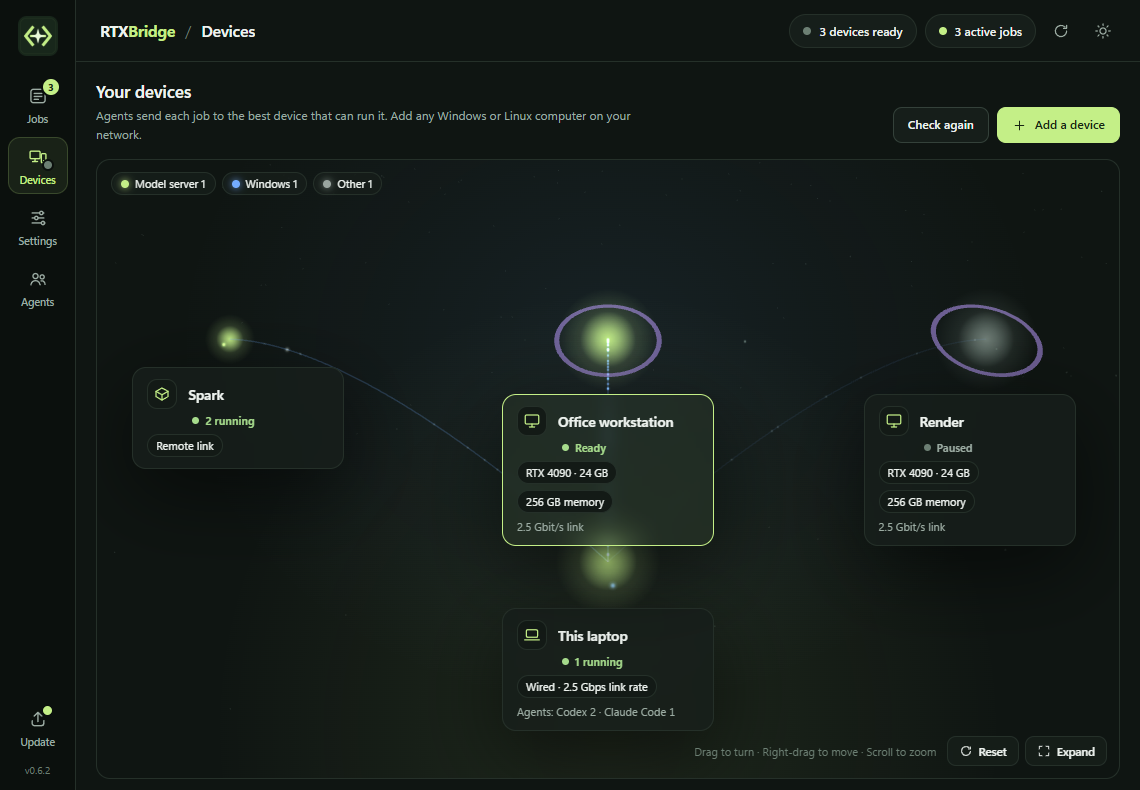
RTXBridge 0.6.2 Devices map browser preview with sample computers, jobs, GPUs, memory and link rates. Sample data; not a current 0.6.4 installed-app capture.
About this app
RTXBridge connects a Windows laptop to owner-controlled Linux compute computers, including NVIDIA DGX Spark and Windows computers with an existing WSL2 Linux environment. It provides a shared job board, resumable project transfer, immutable request and job IDs, automatic file return, cancellation, per-project caches, shared downloads, model servers and stdio MCP for coding agents. Windows work can run as native owner processes; remote Linux work runs in restricted containers on its selected computer. Native laptop execution is not sandboxed.
First setup requires an existing authenticated SSH configuration with a verified host key, Windows OpenSSH and preinstalled Microsoft Edge WebView2. Each remote controller requires supported ARM64 or AMD64 Linux, Python 3, working Docker, systemd user services and sufficient disk/memory headroom. Windows SSH targets need an existing WSL2 distribution and Linux user. Setup installs independent bridge services. Existing Spark phone approval is a separate owner action on the same LAN; optional encrypted public n0 relays can then provide Spark connectivity. Additional computers use independently pinned SSH, with LAN SSH tested and no new-node relay pairing. Their off-LAN availability is unverified. No owner VM is configured or assumed.
Runtime setup downloads a digest-pinned OCI base, installs Debian repository packages and hash-locked Python wheels, then locks jobs to the resulting local image ID. Debian package versions are resolved at setup rather than pinned individually in this release. Optional CUDA provisioning is separate. Dependency preparation downloads locked project packages through a fixed domain allowlist. Normal remote jobs have public HTTP/HTTPS internet access on by default through an isolated proxy that blocks home/private networks, the selected Linux host and cloud metadata; the owner can turn it off. Direct sockets and unproxied external DNS are not supported. CONNECT payloads are opaque and may carry other protocols to allowed public destinations. Jobs can send data to public destinations chosen by their code. Model downloads share one owner-managed writable cache across projects and agents, with idle cleanup and deferred owner clearing. Model servers have no published ports; authenticated calls use durable bounded files and replies expire. The bridge bundles no AI model or provider API credential. Consult the release receipts for the exact tested workflows and remaining phone/hotspot/native acceptance limits.
Windows OpenSSH Client must be installed separately for remote connections. Minimum Windows version and memory are not specified when their compatibility fields use the Marketplace unknown values; this does not assert compatibility with every system. The release receipts record the observed test host separately.
Completed remote job outputs and eligible project changes return automatically to the originating laptop by default. A separate per-user sparkdev-return.exe background worker resumes durable delivery checkpoints without keeping the desktop window open. Setup registers the worker to start at Windows sign-in. Files from /work return to their original project paths; /sparkdev-output files land in the per-job results folder under local bridge state. Returned bytes are hash-verified; concurrent local edits are preserved as conflicts, and paths, secrets and size limits are checked. Delivery failures remain visible and retryable. Delivery completion is separate from workload success; consult release receipts for physical interruption tests. During upgrades, setup stops and restarts the result worker while preserving configuration, pairing, jobs and pending returns. Uninstall removes its sign-in registration and preserves retained state.
Projects can prepare Debian/Ubuntu system packages in a separate derived remote image using a signed repository index and a hash-locked package list. Preparation uses independent temporary resources; ordinary jobs remain nonroot and cannot alter the selected Linux host. Repository package versions resolved at setup and prepared project packages are outside the Windows installer scan. Optional CUDA setup includes FFmpeg; only the ARM64 recipe provisions Blender. AMD64 Blender is not provisioned. NVENC/NVDEC capability is reported from actual cached encode/decode probes tied to the active image, not from encoder names. Blender CUDA/OptiX/CPU render and OIDN acceptance must be read from the separate physical receipts; their presence in a recipe is not proof of GPU operation.
Eligible large LAN transfers use SCP upload packs and SFTP reget for resumable automatic returns through the same pinned OpenSSH host and key checks. Returned files retain hash, path, secret and local-conflict checks; return copies honor disk-reserve and worker time budgets. Paired routes retain RPC transfers. The large-snapshot builder reports bounded health diagnostics. These implementation disclosures do not establish throughput, interruption recovery, installed behavior or network-path acceptance; consult the separate release receipts.
Named computers retain separate connection profiles, controller state, runtimes, policies and return workers. Saving or inspecting a computer does not install software; explicit setup uses the packaged hash-checked bundle. Spark is optional for named remote Linux jobs. Managed native Windows laptop jobs still require the original reachable Spark scheduler; a named controller does not replace that admission dependency. Existing Spark pairing and state are preserved. Each controller enforces its own admission and resource policy.
Automatic placement considers authenticated runtime and available budget observations, including client quotas and explicit memory requirements. Linux system RAM, discrete GPU VRAM and Windows installed RAM are separate observations, not reservations. Docker system-memory caps do not enforce GPU VRAM. Separate jobs may run concurrently on separate computers; each job uses one computer. Distributed model training and cross-host GPU memory pooling are not implemented. The fleet journal retains request/source/target identities before submission and preserves uncertain submissions and worktree claims until verified completion and automatic delivery. Local responses above 40 MiB report incomplete observation, not an offline computer; saved receipts are retained. Future logon/reboot recovery, hotspot and sleep acceptance remain separate from source tests and LAN job receipts.
The standalone Blender fallback builds upstream Blender at 8bf95cbd38d1456c94e9d751f3804eea4d5b137b and NVIDIA OptiX headers at f60c1e44f18426f426a2ed948f28515b3cf67b8a. These are verified Git commit identities, not archive SHA-256 values. Its OCI base digests, two source archives, 66 dependency archives and nine Python wheels are declared with SHA256. The fallback uses only content-addressed HTTPS mirror objects, verifies all hashes and sizes including cache hits, and installs those Python wheels offline. A separate source-bound inventory covers 198 paths backed by 187 data objects: geometry icons, images, a bounded single-stream font and 18 Blender assets inspected with script autoexecution disabled. Nine embedded README Text blocks are prose; no drivers or OSL script nodes were observed. Built-in scene/node behavior remains available. Inventory SHA256: b226e96e7c021f8e53e170acff1e139614dc917380e01023ee245af046636ed6. Inventory: https://github.com/delores88/nvidialink/blob/dbc1e2ca769ef75f443ca3c72d7ff56de48e3667/runtimes/blender/inputs.lock.json. The source build can take substantial time and disk. If the exact already-present owner image sha256:69504fa0aa66263511d356be871df4ab56c8332ea629525fbb832a7249abff62 is available, setup may reuse it read-only; no PhaseForge installation is required. The source pins, image-selection policy and remaining transitive download-declaration gaps are recorded in the manifest validation receipt; direct declarations do not claim a complete fallback build inventory. Blender and its dependencies have their own upstream licenses; the MIT declaration applies to DGXBridge first-party code. The Windows Cargo notice collection does not represent a complete optional Spark runtime license inventory.
RTXBridge was named DGXBridge. The application identity, Marketplace slug, state folders, CLI paths and canonical DGXBridge_VERSION_x64-setup.exe release asset name remain compatible with existing installations. Setup upgrades a legacy installation in place and replaces only its owned legacy registration and shortcuts. The Devices view uses a bundled, locally rendered three.js network map; it does not fetch a remote map service.
Optional password enrollment is an explicit owner-only action. The owner first compares the scanned ED25519 fingerprint with an independently obtained identity for the selected computer. A fresh scan must match that confirmation before any password-bearing SSH connection begins. The password reaches OpenSSH through local standard input and the helper child-process environment; it is not written to configuration, command arguments or bridge logs. Enrollment adds a dedicated public SSH key to that selected account, preserves existing authorized keys, verifies key-only login and saves the independently confirmed pin. Agents cannot invoke enrollment through MCP; existing pinned manual SSH setup remains available.
Feature status
Publisher-disclosed limitations for individual features.
Codex Windows sandbox
BETA
Historical release evidence: Claude Code and Codex MCP jobs ran concurrently on the physical Spark. The prior restricted Windows shell check failed with missing writable-root capability SIDs; no global security setting changed. No new 0.6 Claude Code or restricted-shell acceptance is claimed.
Remote and disconnect acceptance
EXPERIMENTAL
LAN SSH and phone-approved pairing were exercised. Owner-VM or phone-hotspot execution, physical network-drop tests and laptop sleep during a run remain unverified. Controller restart during a Spark job was tested separately.
Laptop scheduler and runtime provisioning
BETA
New managed laptop jobs require a reachable Spark scheduler. Native laptop commands use owner permissions and have no result cache. Spark runtime bases and wheels are pinned; Debian packages are resolved during setup before the resulting image ID is locked. Runtime provisioning is outside the Marketplace installer/source scan.
Automatic file return and GPU tools
BETA
The local background worker retries unfinished delivery after reconnect or restart. Workload exit status and file delivery status are separate. GPU video is reported only from cached actual probes bound to the active image; Blender render and GPU denoising acceptance require physical receipts. No phone-hotspot, sleep or hardware success is inferred from source tests.
Multiple compute computers
BETA
Named Linux and Windows/WSL controllers have independent state and pinned SSH. Separate jobs can overlap across computers; each job uses one computer. LAN CPU, RTX 4090 CUDA and file-return evidence is separate from installed startup and off-LAN acceptance. AMD64 Blender, distributed training and cross-host GPU memory pooling are not implemented.
RTXBridge Devices and owner enrollment
BETA
The unified Devices map, independently confirmed password-to-key enrollment and legacy-name installer migration have separate source, isolated enrollment, installed and network receipts. A fresh password sign-in is not inferred from a preexisting SSH-key job.
External services & costs
Owner-controlled NVIDIA DGX Spark: Hardware, electricity, storage and network access are supplied by the owner; the bridge does not provide hardware or hosted compute.
Owner-selected Linux or Windows/WSL compute computer: The owner supplies hardware, storage, memory, network, Docker and any Windows/WSL prerequisites. This utility supplies no hosted compute. No GPU or system memory is pooled between computers.
OpenSSH and Microsoft Edge WebView2: Install prerequisites separately. This installer does not download WebView2 or request administrator elevation.
ipify public IPv4 observation: A third-party service with its own availability and terms sees the helper public IP and ordinary connection metadata. The request sends no project contents or credentials.
Public n0 iroh relays: Optional third-party network infrastructure has its own availability and terms; relay operators can observe connection metadata.
Claude Code, Codex or another CLI client: Agent accounts, subscriptions and any model API charges remain separate from this free utility.
Container and package registries: Transfers use owner bandwidth and disk. Prepared remote jobs can use LAN SSH without public internet; each needs its selected controller. Native Windows jobs retain the original Spark admission dependency.
Owner-controlled NVIDIA DGX Spark — Optional Optional ARM64 compute computer and existing phone-paired route. Its reachable scheduler remains required for managed native Windows laptop jobs. Hardware, electricity, storage and network access are supplied by the owner; the bridge does not provide hardware or hosted compute.
Owner-selected Linux or Windows/WSL compute computer — Required At least one remote compute controller is required for remote jobs; Spark can supply it. Additional ARM64/AMD64 computers use pinned SSH, Docker and independent user services; Windows targets need WSL2. The owner supplies hardware, storage, memory, network, Docker and any Windows/WSL prerequisites. This utility supplies no hosted compute. No GPU or system memory is pooled between computers.
OpenSSH and Microsoft Edge WebView2 — Required Pinned SSH connects to each selected remote computer; preinstalled WebView2 displays the Windows app. Install prerequisites separately. This installer does not download WebView2 or request administrator elevation.
ipify public IPv4 observation — Optional Each public-internet helper checks api.ipify.org at startup and every 30 seconds to block its observed public egress address. Online access fails closed when the check is unavailable or stale; offline jobs do not require it. A third-party service with its own availability and terms sees the helper public IP and ordinary connection metadata. The request sends no project contents or credentials.
Public n0 iroh relays — Optional Owner-enabled encrypted remote device connectivity after pairing; no owner VM is included. Optional third-party network infrastructure has its own availability and terms; relay operators can observe connection metadata.
Claude Code, Codex or another CLI client — Optional Calls the common CLI or stdio MCP interface; the bridge itself does not invoke a model API. Agent accounts, subscriptions and any model API charges remain separate from this free utility.
Container and package registries — Required Initial runtime provisioning and locked dependency preparation use fixed hosts. Job-directed public HTTP/HTTPS requests can upload and download data at other destinations. Transfers use owner bandwidth and disk. Prepared remote jobs can use LAN SSH without public internet; each needs its selected controller. Native Windows jobs retain the original Spark admission dependency.
Privacy & permissions
Selected project files, job arguments and model-server call bodies are sent to the owner-selected compute computer; output and model replies return to the laptop. Remote job internet is enabled by default and the owner can disable it. Beyond the fixed provisioning and relay hostnames listed in permissions.domains, job code may send data to arbitrary public HTTP/HTTPS destinations it chooses. Those destinations cannot be exhaustively listed in advance; permissions.domains is not the job proxy allowlist. The proxy blocks private addresses, observed remote host/on-link networks and cloud metadata. Each public helper checks its observed public IPv4 using fixed credential-free HTTPS requests to api.ipify.org at startup and every 30 seconds, and also blocks that IP. Observations expire after 60 seconds; failed or stale checks cut public internet. The service sees the helper public IP and connection metadata, not project contents or job arguments. Additional router public aliases and addresses used by other outbound routes are not discovered. These controls do not prevent a job from uploading data to public services. Optional relays see connection metadata while device payloads remain encrypted. No provider API credential is bundled.
Filesystem: Read the selected project tree and write application configuration, logs, receipts and pending cancellations., Native laptop jobs execute with the owner account and can access files that account permits; they are not a sandbox., Write bridge state, source snapshots, per-project build caches, shared model/download caches and model-call spools on the selected remote computer; install its user service units., Shared downloads form one writable owner trust domain across projects and agents., Write verified returned outputs and eligible project changes to the original local project; preserve conflicting local edits and retain delivery checkpoints., Install a per-user background result worker and Windows sign-in entry; updates preserve pairing, job state and pending returns., Prepare hash-locked Debian/Ubuntu packages in separate remote images using signed repository metadata; do not install them on the host., Write temporary upload packs and bounded materializer health on the selected computer; the builder discards stdout and stderr., Prune stale queued remote snapshots and their partial trees under age and lock checks; preserve completed snapshots and content-addressed chunks., Store independent computer profiles and immutable fleet request/target identities, claims and per-profile automatic-return checkpoints in owner-local state., On owner enrollment, retain a dedicated SSH key pair and host pin locally; add only its public key to the selected remote account, preserve existing keys and save the verified profile.. Network domains: deloresai.com, api.ipify.org, registry-1.docker.io, auth.docker.io, nvcr.io, deb.debian.org, security.debian.org, pypi.org, files.pythonhosted.org, crates.io, static.crates.io, index.crates.io, registry.npmjs.org, release-assets.githubusercontent.com, objects.githubusercontent.com, github-releases.githubusercontent.com, use1-1.relay.n0.iroh.link, usw1-1.relay.n0.iroh.link, euc1-1.relay.n0.iroh.link, aps1-1.relay.n0.iroh.link, ports.ubuntu.com, archive.ubuntu.com, security.ubuntu.com, projects.blender.org, github.com, codeload.github.com. No OS elevation declared.
All downloads
Choose the computer you’re downloading for. Other-platform downloads never install automatically.
BetaMore features are coming. This is an early release.
Release checks cover the downloaded files. They do not establish production readiness or validate the app’s results.
Stable downloads are selected. Choose an early release only if you want to try it.
Choose the operating system and processor of the destination computer. Downloads do not install automatically. This website does not inspect your device or check whether required hardware and runtimes are installed.
Platform
Package
Size
Verification
Action
Windows x64Minimum OS: Not specifiedA tested minimum OS version has not been established.Publisher-declared required runtime: Microsoft Edge WebView2
Automated static checks inspected release and package identity, malware, dependency inventory, vulnerability advisories and potential secrets in supported files. Secret scanning skips native PE, ELF and Mach-O binaries. High and Critical dependency findings block admission; lower-severity advisories remain visible. Review individual results for actual coverage and expiry. Native lifecycle and full source-code security validation are not established by these checks.
Installer signing: Unsigned — this installer does not have a publisher signature.
Minimum operating system
Not specified
Minimum RAM
Not specified
Recommended free space
190 MB plus space for application data and backups
Publisher-declared required runtimes
Microsoft Edge WebView2
These prerequisites are publisher declarations. This website does not inspect your device or verify that it meets them.
The package’s operating system and processor identity were checked. Installation compatibility and minimum system requirements have not been established by runtime testing.
Installer file identityPassed
The exact GitHub release asset bytes, SHA-256 digest and size were checked.
Package and architecturePassed
The nsis package and its x64 application payload were inspected without running the application.
Publisher authorizationPassed
Current repository access, publisher ownership and free distribution authorization were verified.
Source and release identityPassed
The GitHub release, declared channel, asset IDs and immutable source commit match this review.
Malware scanPassed
installer: passed; source: passed; payload-1: passed; payload-4: passed; payload-3: passed; payload-2: passed All planned files required; expected scans exclude empty files. Plan sizes are not content hashes. Null=unknown; child CPU/RSS sampled, not aggregate. Raw streams digest-framed in plan order. {"planSha256":"5afca06d9e681830e5952a243200c68f13cb6b91d0be1be72adf255d635902db","scopeFiles":{"installer":1,"source":352,"payload":873},"columns":["id","status","error","plannedFiles","plannedBytes","expectedScannedFiles","scannedFiles","infectedFiles","startMs","elapsedMs","cpuMs","peakRssBytes","termination","exitCode"],"groups":[["installer","passed",null,1,13593490,1,1,0,190,70355,68000,1214889984,"exited",0],["source","passed",null,352,7512742,352,352,0,196,38395,36830,1024561152,"exited",0],["payload-1","passed",null,115,22333437,115,115,0,204,32561,31130,1033760768,"exited",0],["payload-4","passed",null,305,9880275,305,305,0,208,41803,40000,1181028352,"exited",0],["payload-3","passed",null,228,14895230,228,228,0,32766,32952,32130,1190559744,"exited",0],["payload-2","passed",null,225,15087994,225,225,0,38591,25520,25240,1188343808,"exited",0]]}
Dependency inventoryPassed
Inventoried 889 source dependencies and 841 packaged dependencies. Exact linked source snapshot and passively extracted installer; no application code executed.
Dependency vulnerability assessmentPassed
High and critical vulnerabilities block publication. Dependency findings: 0 critical, 0 high, 1 medium, 0 low, 0 unknown, 0 info. High and critical findings block publication; lower severities are advisories. Exact linked source snapshot and passively extracted installer; no application code executed. 1 lower-severity or unrated advisories remain; the publisher receives the detailed findings.
Secret patterns in supported filesPassed
Gitleaks checks recognizable credential patterns in supported source/extracted text and passively extracted CPython 3.12 literal constants. Native PE, ELF and Mach-O binaries are skipped. Constants are scanned separately; variable assignments, dynamically assembled values and program behavior are not reconstructed. This is not comprehensive bytecode analysis. 1225 input files were supplied; the inspected-file count is not measured. 0 unreviewed potential embedded credentials remain from 0 original tool matches. Values are never included in reports.
Publisher signingNot required
Trusted operating-system publisher signing was not established. This release policy permits that disclosed limitation.
Installation and application behaviorNot run
Native installation, launch, update and uninstall testing has not run in this static review.
Comprehensive source analysisNot run
Dependency and secret scans do not constitute comprehensive source-code or application behavior analysis.
Reproducible build provenanceNot run
Source commit identity is checked; reproducing the binary from source is outside this review.
Scan age and unavailable rescans do not remove this release’s approval. The original check dates remain visible; each download requires fresh authorization.
These checks apply to this exact file. They do not guarantee all future behavior. About release verification
Sign in to download this app, or create a free account. Browsing the marketplace is public.
BUILT WITH YOUR FEEDBACK
Community
Share what works, what needs fixing, and what should come next.
Loading the conversation…
to share feedback or give a thumbs up. Feedback is public.
PRIVATE WORKFLOW REPORTS
Report a problem with RTXBridge
Visible only to the person submitting the report and this app’s publisher team. Reports are never posted to public Community feedback.